Signs of Team Burnout (Before It Becomes Turnover)
By the time someone hands in their resignation, you missed the warning signs by 6–9 months. Here’s how to spot team burnout before it becomes a retention crisis.

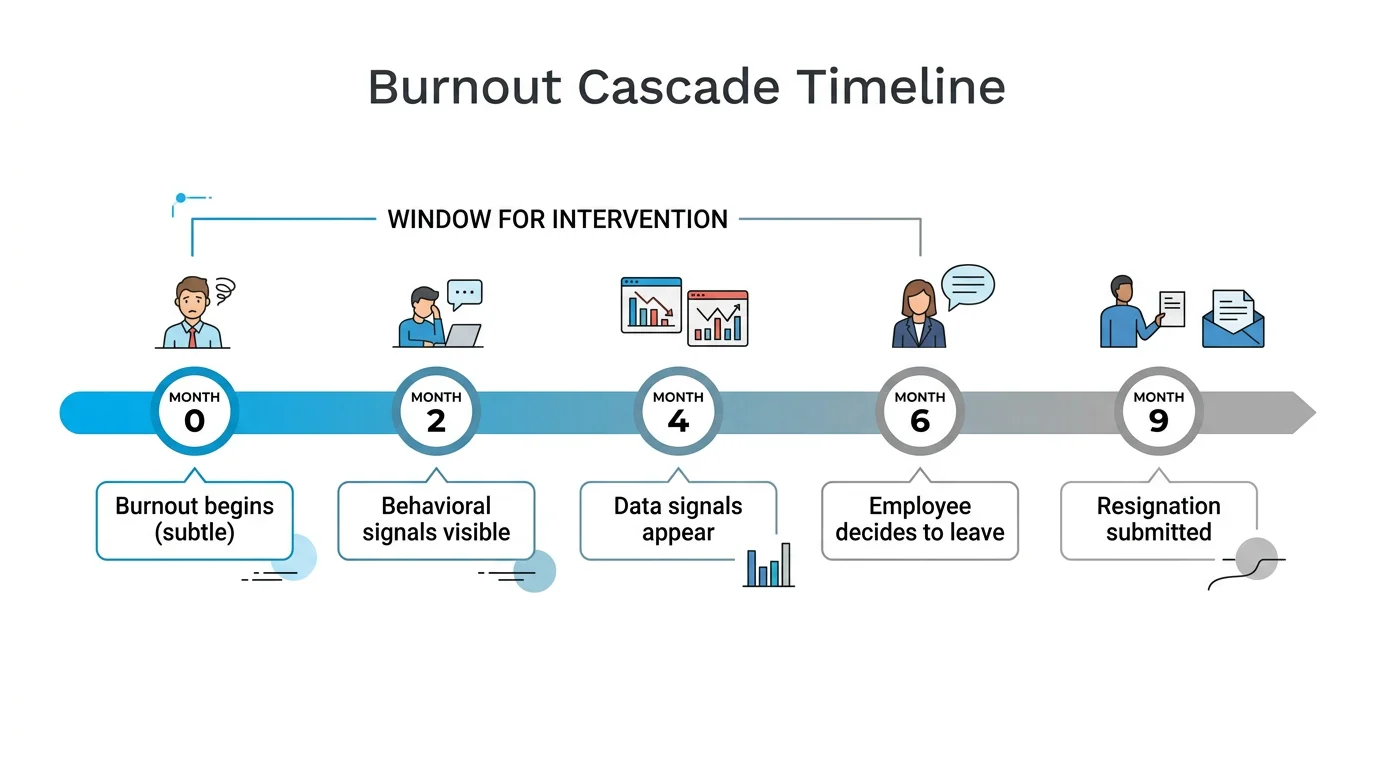
The average employee who quits due to burnout made that decision 6 to 9 months before submitting their resignation. That’s the finding from Gallup’s ongoing workforce research, and it means that by the time you’re doing an exit interview, you’re conducting an autopsy, not a diagnosis.
What’s worse: burnout rarely hits one person in isolation. It moves through teams like a contagion. When one high-performer disengages, workload shifts to the remaining team members, accelerating their own path to burnout. By the time the first resignation lands, three more are already being drafted.
Here’s the thesis: individual burnout is visible. Team burnout is invisible until it’s catastrophic. Most People leaders are trained to spot burned-out individuals. Almost none have a framework for detecting when an entire team is sliding toward collapse. That’s the gap this article addresses.
If you want the full picture on how widespread this crisis is, the latest burnout statistics are sobering. 76% of U.S. workers now report experiencing burnout. But raw numbers don’t help you intervene. Knowing what to look for does.
Why team burnout is harder to spot
Individual burnout has recognizable symptoms. The person who used to be enthusiastic goes quiet. Deadlines slip. Performance reviews decline. A good manager catches it.
Team burnout is different. It doesn’t announce itself through a single person’s behavior change. It shows up as a slow, collective drift: a gradual erosion of energy, connection, and discretionary effort that’s easy to rationalize away as “a tough quarter” or “just the nature of the work right now.”
Three things make team-level burnout particularly dangerous:
It normalizes. When one person is burned out, the team notices. When the whole team is burned out, nobody notices, because there’s no healthy baseline to compare against. Cynicism becomes culture. Low energy becomes “how things are.”
It’s self-reinforcing. Burned-out teams produce lower-quality work, which creates rework, which increases workload, which deepens burnout. The feedback loop is vicious and accelerates without intervention.
It spreads across team boundaries. Gallup’s research shows that disengagement in one team predicts rising disengagement in adjacent teams within 2–3 quarters. Burnout doesn’t respect org chart lines.
The behavioral signals
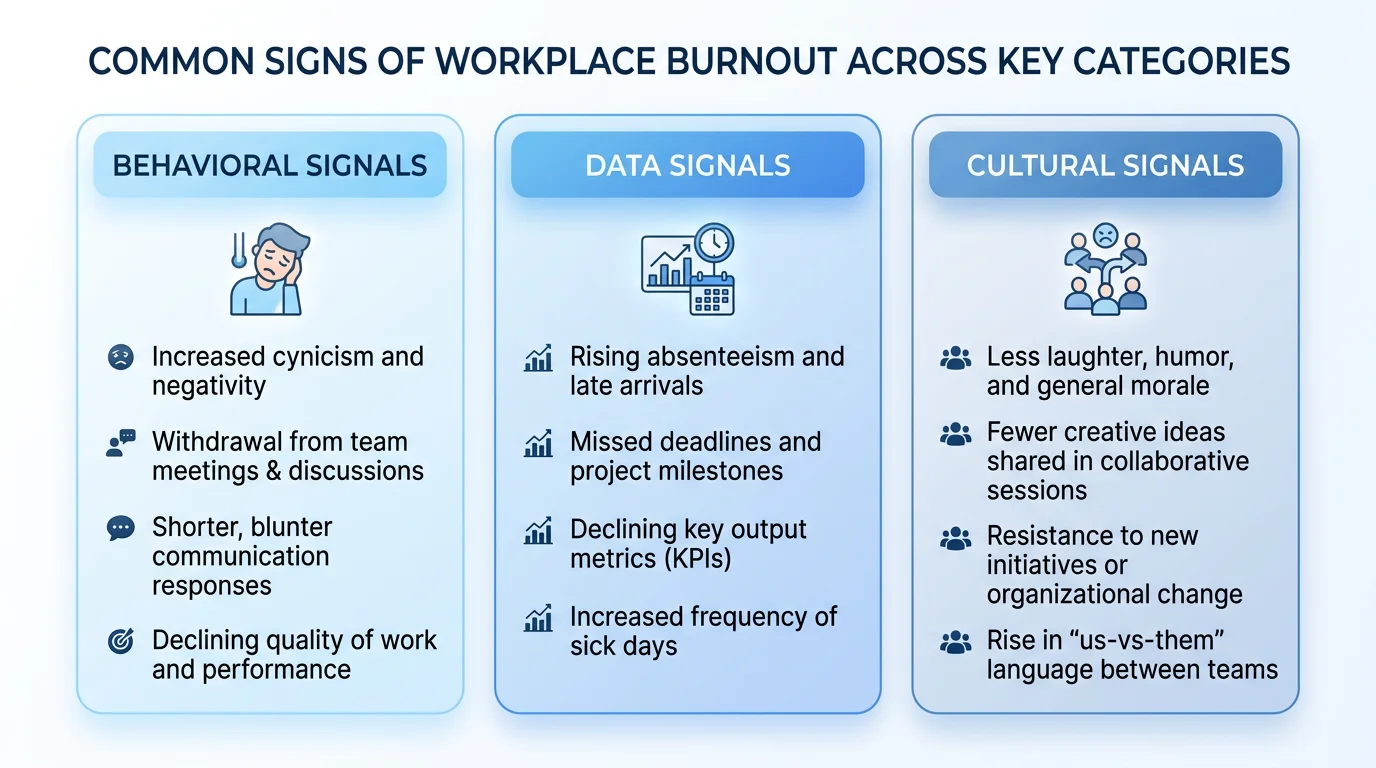
These are the changes you can observe in how a team operates day to day. None of them individually proves burnout. Three or more occurring simultaneously is a pattern you cannot afford to ignore.
Declining meeting participation
Watch what happens in team meetings. Burned-out teams stop contributing. The same two people talk while everyone else sits on mute. Questions get met with silence. Brainstorming sessions produce nothing. People show up on time and contribute the minimum required to not be noticed.
The leading indicator isn’t attendance. It’s participation quality. A team that dutifully joins every meeting but has stopped offering ideas, pushing back on proposals, or asking clarifying questions is a team that has mentally checked out.
Camera-off culture
This one is nuanced. Not every camera-off is a burnout signal. But when a team that previously defaulted to cameras-on gradually shifts to cameras-off, without anyone explicitly deciding to change the norm, pay attention.
Research on remote worker loneliness shows that reduced visual presence correlates with declining felt connection. Cameras going off is often the first visible sign that people are creating emotional distance from their team.
Shorter, flatter communication
Burned-out teams stop elaborating. Slack messages get shorter. Emails become transactional. The casual context, the extra explanation, the “here’s what I was thinking.” All of it evaporates.
This is withdrawal, plain and simple. When people stop investing energy in making their communication rich and clear, they’ve stopped investing in the relationship with their teammates.
Vanishing discretionary effort
This is the most reliable signal and the hardest to measure. Discretionary effort is everything employees do above the minimum: staying an extra few minutes to help a colleague, flagging a potential problem they could have ignored, volunteering for a stretch project.
When discretionary effort disappears across an entire team, you’ll feel it before you can quantify it. Projects complete on time but feel hollow. Quality is acceptable but uninspired. Nobody is failing. Nobody is thriving either. The team is functioning but no longer performing.
The data signals
Behavioral signals require judgment. Data signals don’t. These are the metrics already sitting in your HRIS and engagement platforms that indicate team burnout if you know how to read them.
PTO usage patterns
Counterintuitively, both extremes are warning signs. A team where nobody takes PTO is white-knuckling through unsustainable workloads, too afraid or too overloaded to step away. A team where PTO usage suddenly spikes (especially short, unplanned absences) is showing the physical toll of chronic stress.
Deloitte’s research found that 83% of burned-out employees report it negatively affects their personal relationships and health. That manifests as sick days, mental health days, and “personal days” that cluster in patterns you can track.
Declining engagement survey scores (at the team level)
Most companies look at engagement survey data at the org level. That’s too coarse. The signal is in the team-level breakdown.
A team whose engagement scores drop 10+ points between surveys is in trouble, even if the org average holds steady. And if adjacent teams start declining in the following survey cycle, you’re watching burnout propagate through your org in real time.
Rising turnover in adjacent roles
By the time someone on a burned-out team quits, the signal is obvious. The leading indicator is subtler: watch for turnover in roles that interface heavily with the team in question. When a burned-out team’s dysfunction starts pushing out their cross-functional partners (the PM who works with a struggling engineering team, the designer embedded in an overwhelmed product squad), that’s the early warning system.
The cost of this turnover compounds fast. At replacement costs of 50–200% of annual salary, a single burned-out team can generate hundreds of thousands in hidden costs before anyone connects the dots.
The cultural signals
These are the hardest to quantify and often the most important. They show up in how people talk about their work, their team, and their company.
Pervasive cynicism
There’s a difference between healthy skepticism and burnout-driven cynicism. Healthy skepticism sounds like “I’m not sure this approach will work, here’s why.” Burnout cynicism sounds like “Sure, another initiative. Let’s see how long this one lasts.”
When a team defaults to cynicism about new projects, leadership decisions, or company direction, they’ve lost the belief that things can improve. That’s a hallmark of the depersonalization dimension of burnout that the WHO formally recognizes.
Quiet quitting as team norm
“Quiet quitting” as a term is overused. But when an entire team collectively recalibrates to doing exactly what’s required and nothing more, that’s a burnout response. They’ve learned that extra effort doesn’t get rewarded, problems don’t get fixed, and investing energy beyond the minimum isn’t worth the cost.
Resistance to new initiatives
Burned-out teams push back on everything, not because the ideas are bad, but because they have no capacity to absorb change. If your team’s response to every new tool, process, or initiative is “we don’t have bandwidth,” believe them. They’re telling you they’re running on empty.
This is also why wellness stipends and individual perks fail with burned-out teams. Offering a meditation app subscription to someone who can barely keep up with their current workload doesn’t feel like support. It feels like one more thing on the list.
What to do when you see the signs
Here’s where most People leaders make a critical error: they respond to team burnout with individual interventions. One-on-ones. Coaching conversations. EAP referrals. Wellness perks.
These help, but they’re insufficient on their own. You cannot solve a systemic problem with individual solutions. If the workload is unsustainable, no amount of check-ins will fix it. If the meeting culture is draining, a mindfulness app won’t restore energy.
The interventions that actually work share a few characteristics, and they’re the same ones the research points to for reducing burnout across remote teams.
1. Address the structural cause
Before you do anything else, diagnose why the team is burning out. Is it workload? Staff it properly, cut scope, or extend timelines. Is it meeting overload? Audit the calendar and eliminate everything that isn’t essential. Is it a leadership problem? That’s a harder conversation, but avoiding it guarantees the burnout continues.
No wellness intervention will compensate for a structural problem you refuse to fix.
2. Build recovery into the workday
Don’t ask burned-out people to find time for self-care. They won’t. They can’t. Instead, embed brief recovery moments into existing team rhythms.
A JAMA Network Open study of 1,458 UCSF employees found that just 5 minutes of daily mindfulness practice reduced burnout with an effect size of 0.39 and improved work engagement, with benefits persisting at 4-month follow-up. But what mattered was consistency and low friction, not duration.
Five minutes at the start of a team meeting costs almost nothing. It requires zero individual initiative. And the research shows it works, especially when practiced as a team, where the “social presence effect” provides approximately 7% additional benefit over identical solo practice.
3. Make it collective, not individual
The single most important shift: stop treating burned-out teams as collections of burned-out individuals. They’re not. They’re dysfunctional systems that need system-level intervention.
Team-based recovery rituals accomplish something individual wellness perks never can: they give everyone permission to pause at the same time. Nobody feels guilty for stepping away because the whole team is doing it together. That psychological safety is what makes the difference between a wellness program that gets ignored and one that actually changes how a team operates.
An actionable framework for People leaders
If you suspect a team is burning out, here’s a concrete diagnostic and response protocol:
Week 1: Diagnose. Pull the data signals (engagement scores, PTO patterns, turnover in adjacent roles). Cross-reference with behavioral observations from the team’s manager. Don’t rely on self-report alone. Burned-out people often can’t accurately assess their own state.
Week 2: Address root causes. Have an honest conversation with the team lead about workload, staffing, and meeting load. Make at least one structural change: cancel a recurring meeting, deprioritize a project, bring in temporary support. This signals that you’re taking the problem seriously at a system level.
Week 3: Introduce team-level recovery. Build a brief, shared ritual into the team’s existing calendar. Five minutes of team mindfulness at the start of a weekly meeting. A structured reflection at the end of a sprint. Something consistent, brief, and non-optional. The specifics matter less than the consistency and the shared nature of it.
Ongoing: Measure and adjust. Track the data signals monthly. Are engagement scores stabilizing? Is PTO usage normalizing? Is participation quality improving in meetings? If not, the structural problem hasn’t been fully addressed. Go back to step two.
The teams that recover from burnout are the ones whose leaders caught it early and responded systemically. The teams that lose their best people are the ones whose leaders saw the signs, rationalized them away, and waited for the exit interviews to confirm what was obvious six months earlier.
Don’t be the leader reading this and recognizing your team. Be the one who catches it in time.
Pauso brings 5-minute team mindfulness sessions into your existing calendar. No app downloads, no individual accounts, no willpower required. See how it works.
Related articles



Wellbeing your team will actually use
Pauso is a short breathwork reset on your team’s calendar. Flat price per company, not per seat, and nothing for anyone to install.